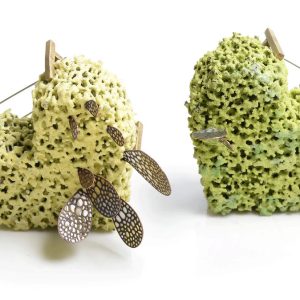
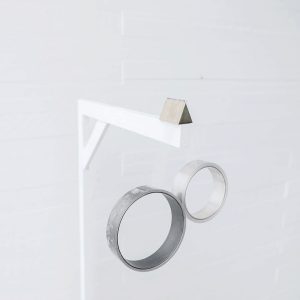
• Aisegul Telli, 2016, Turkey

    Aisegul Telli, Turkey

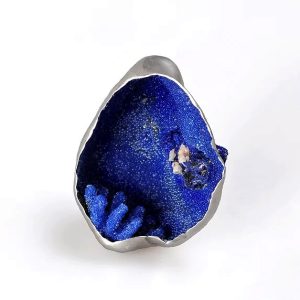
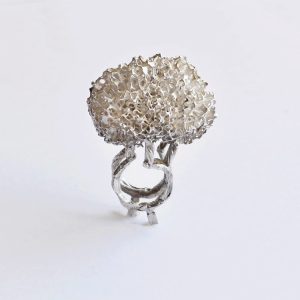
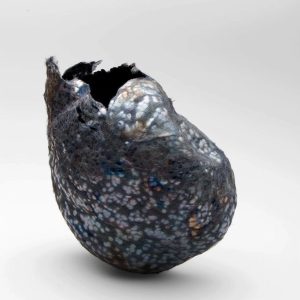
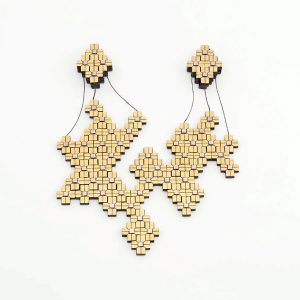
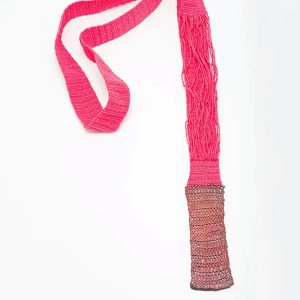
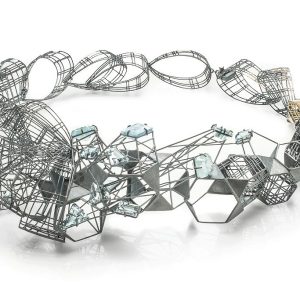
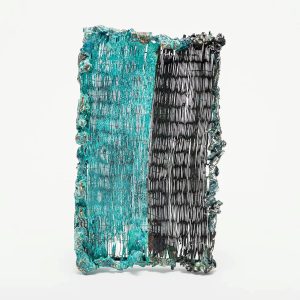
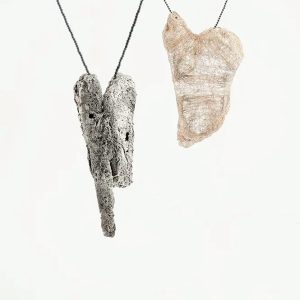
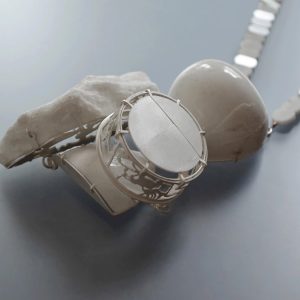
    The blue universe

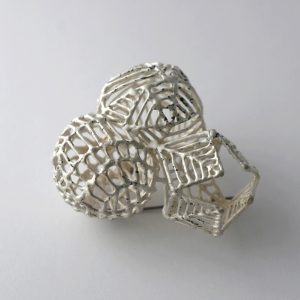
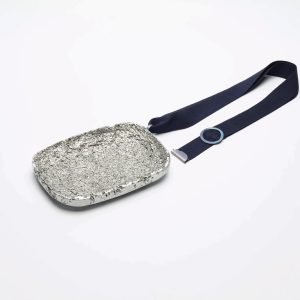
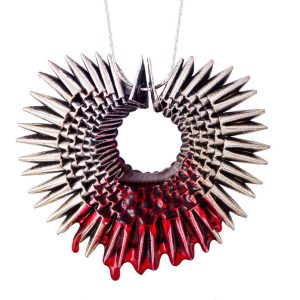
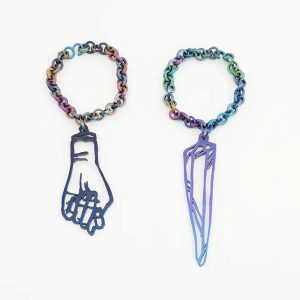
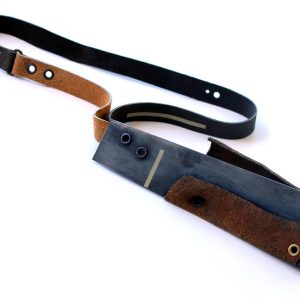
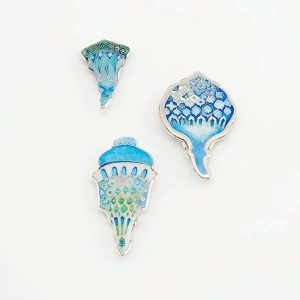
    These jewellery pieces were created in recognition of bonds between human and the blue magical universe beneath. We need to defend the environment of oceans and the life of its residents. Destruction must be stopped and the value of waters surrounding our lands must be understood before it is too late.

    Silver plated brass, steel, resin, pigment, glass, natural stone

  • Ana Cristina Berrio, 2016, Colombia

    Ana Cristina Berrio, Colombia

    Perimeter

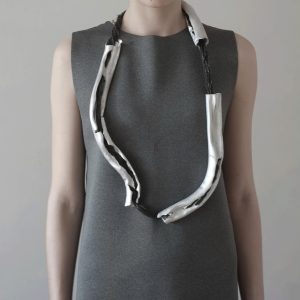
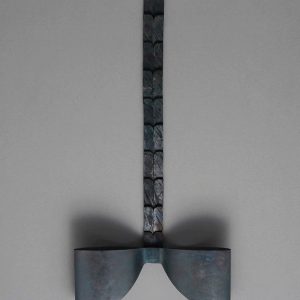
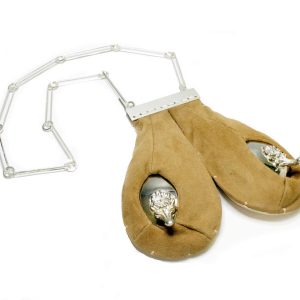
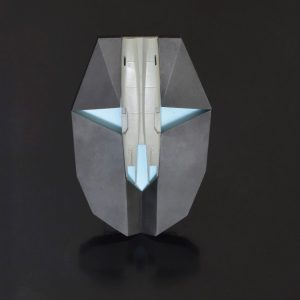
    The planes act as living beings. They thrive on experiences, emotions, meetings, and daily life that we place on them; the planes grow through aterritory, they are deployed with shapes that form topography. the bonds between the piece, the body, and the material are created by our movements and form human body topography.

    Painted steel, felt, neoprene, 47×14×14cm

  • Andrea White, 2016, USA

    Andrea White, USA

    Light

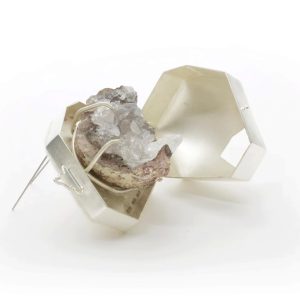
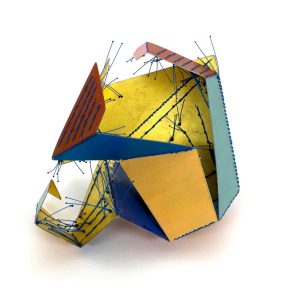
    Throughout human history, metal has been a means to communicate status and symbol. Metals have been instilled with different symbolic meanings by various cultures, yet each metal seems to carry its own common language that can be interpreted by anyone. As an artist working with metal, I have to understand what the materials are conveying to the viewer, and how those interpretations fall in line with the intensions of my piece. The bond that is built during the formation of a piece stems from an appreciation of metal and its meaning. In the end, the metal retains its own cultural and geological significance, while also lending itself to speak for the piece. Light speaks to the relationship between the cultural significance of a reliquary, and the refractory properties of its materials.

    Sterling silver, jade, wool felt, silk cord, 7,6×6,4×3,8cm

  • Andreia Gabriela Popescu, 2016, Romania

    Andreia Gabriela Popescu, Romania

    A little gold

    The collection “Walls of Civilization” reinterprets the age-old tale of lost treasure, hidden by the ancient Dacian civilization of Romania in the face of imminent Roman invasion. I proposed an interpretation of the treasure as a value that overcomes the borders of nationality and transcends into the collective memory. I reach the point where we have the same ancestors not by affiliation, but through cultural identification. Treasures buried deep in the ground, in the riverbeds – found, lost, and found Again.

    A golden treasure. But more than all the wealth of the nation is the legacy left for its descendants through architecture, knowledge, culture, and history. I used the wall marks of the Dacian citadels, marks from chambers, connecting halls and entrances. Walls bearing the timestamp, unearthed or partially buried, reminding of the mix of dirt and sand, of the fortress and archaeological digs in shades of white, grey and gold metal. I used gold only as a binder between the bricks.

    Gold-plated copper, Ø 16,5cm
  • Andrzej Boss, 2016, Poland

    Andrzej Boss, Poland

    ~

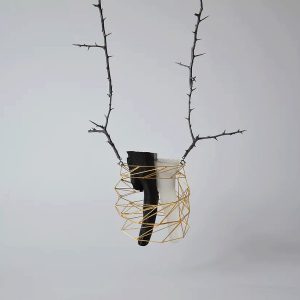
    For creating jewellery I use the basic tool of an artist – the fingers. In this piece, the fingers are presented in a recognisable gesture of victory. The message of my work depends on its decorating elements. Does the addition of a precious metal such as gold sublimate the work or does it have an opposite effect? A golden cage can create a sense of isolation and drastic confinement alters the symbolic meaning. With this in mind, this work speaks of a feigned Victory.

    Silver, resin, gilded steel, 12×9,5×9,5cm

  • Anja Eichler, 2016, Germany

    Anja Eichler, Germany

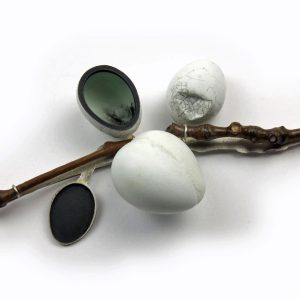
    Float

    “The femme fragile” is an image of a woman that was especially popular at the end of the 19th century. The femme fragile attracts attention by her tender beauty. She is pure, weak, and needs male protection. In my work, i refer to this historic portrait as well as to asia where this image is still existent. However, looking fragile does not necessarily mean being fragile. Moreover, weakness might as well turn out to be strength if it helps control one’s environment.

    Quail eggs, branch, oxidised silver, steel wire, 13×7×3,4cm

  • Anna Vlahos, 2016, Greece

    Anna Vlahos, Greece

    Tetraptera

    My work explores the visual languages of my two homes. The first one, Australia, talks to me by the shapes and textures from the environment. When I moved to Athens, I felt the absence of this nature for a long time. Eventually, I found a new nature in the ancient artefacts that come out of the ground as though growing there. I also found it in the imagery used by ancient artisans to describe their world. From the lines and motifs of the ancient artwork, I create models, which I use to build new shapes. Inspired by nature of Australia and the ancient art, I illustrate and explore the bond between my two homes.

    Sterling silver, stainless steel clasp, 5,5×4,5×2,5cm

  • Anne-Sophie Vallée, 2016, Canada

    Anne-Sophie Vallée, Canada

    Fluff, Hair, Pine

    I aim to propose a platform for interaction through the pieces of jewellery I create to initiate and develop a bond with the wearer. Playing provides endless possibilities of escaping the ordinariness of everyday life and invites us to take part in unusual contexts, making us question the idea of reality. Since the notion of play enables communication of experience in a sensitive way, it carries the potential to link and harmonise the personal and the social body at the non-rational level.

    Through free play and improvisation, we are able to connect outside of the physical known and access other spaces. I make jewellery that seeks to increase the participative role of the wearer in the work’s possible form, function and meaning, deepening in this way one’s own particular link with the piece.

    Steel, powder-coated, 10×9×2cm

  • Anneli Oppar, 2016, Estonia

    Anneli Oppar, Estonia

    Silent action 1

    I act because I want to understand the relationship between metal and a person. Situations that are in permanent progress lose their familiarity and become unknown and strange. For some reason, these situations keep appearing and they are never fully understandable. Therefore, I feel a need for intervention.

    My relationship with metal is rather careful. I want to preserve the features that the material already possesses. For example, if the surface of the material is about to collapse, I try to avoid destruction. I feel my presence at this moment. My actions make deformation happen, but it can also happen without my inter- vention. My task is not about changing something, but adding something. This way, I make a connection with nature. So my presence, as an artist, is rather silent than loud by its nature.

    Recycled aluminium, synthetic rope, 43×31×4cm

  • Aric Verrastro, 2016, USA

    Aric Verrastro, USA

    Horizonte

    I have recently been displaced from living in a city, which has left emptiness in my life. The creation of each piece has become a method to fill the void and a reflection of the many aspects of city life. The forms are architectural, modular, constructed from steel, becoming allegorical representations of the energy of a thriving, vibrant environment. The variations of forms show diversity and are linked to concepts of dancing lights and the beautiful musical chaos in the streets. Steel is painted with vibrant colours giving vitality to the cold, hard material. Stitching softens the hard-edged forms creating a sense of comfort and approachability paralleling my nostalgia for city life. The thread acts as a metaphorical timeline of an individual’s pathway meandering through the busy streets. Each break in the thread signifies a person amongst the many. The human body completes the piece of jewellery as people fill and give life to architectural spaces, expressing the vitality and connection I feel towards the urban human experience.

    Mixed media, 10×12×7cm

  • Brice Garrett, 2016, USA

    Brice Garrett, USA

    You, the Possessed (1.1-1.4)

    Using metal and production processes as the conceptual foundation, the work attempts to negotiate between contemporary and traditional ideologies of reproduction, economy, productivity and value within the lens jewellery. Through the material, I navigate personal conundrums between efficiency and authenticity.

    A mould is a tool with a single function to reproduce the nega- tive cavity bonded within. After each cast, I carve and deconstruct the mould, destroying its single purpose. The pieces evolve and a new body emerges, removing the traces of the original object.

    Jewellery, being a relational aesthetic, is rooted on the body yet maintains a fundamental mobility within the physical world embodying the intimate, the public, and the social. Through the cathartic deconstruction and manifesting into jewellery, they become extensions of our bodies.

    Silver, 4,4×3,8×0,7cm

  • Christa Lühtje, 2016, Germany

    Christa Lühtje, Germany

    ~

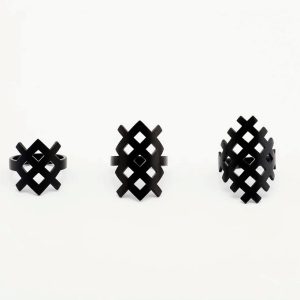
    Metal was my choice from the very beginning. I like working with silver and iron depending on the type of concept I am working on. Their characteristics and expressions are opposite. Dealing with gold is a requirement, it is sensual and lively, expression of joie de vivre, a wonderful material to work with. Iron is lighter, harder, au naturel, black, not precious, yet aesthetically inspiring. Both metals are good companions in everyday life – they become more and more lively and charming when worn. Finding an adequate way to work with these materials is a real Challenge.

    Iron, 2,1×2,2cm, 3,2×2,2cm, 3,3×2,2cm

  • Claire Lavendhome, 2016, Belgium

    Claire Lavendhome, Belgium

    &

    I desire to change the invisible (memories, senses, being) through the visible by my pocket jewellery. I am also looking for a sensual and tactile contact between the jewel and the hand.

    Silver is used in this work for its sensation as well as for its sound when I create sound jewellery. There is a tactile bond between the pocket jewellery and the hand. When held in hand, the metal slowly warms Up…

    Silver, gold, clay, 6×3×1cm, 4,5×4,3×1cm, 20×9×1cm

  • Ditė Dilginienė, 2016, Lithuania

    Ditė Dilginienė, Lithuania

    Babel

    Communication (in Latin communicatio means ‘sharing, imparting’; it comes from the Latin communico meaning to ‘share’; cf. communis – ‘common’) is defined as an act of exchange of information. It is an inherent need of all living beings. For an individual, an absolute absence of communication is always a sign of decline, degradation, and destruction. And vice versa, the presence of it indicates prosperity and growth. Thus this work is, in a way, an ode for correlation, an expression of gratitude to all of those whose words opened up new paths and led to the discovery of a new existential weight.

    Silver 925, gold 585, 6×7cm

  • Dovilė Bernadišiūtė, 2016, Lithuania

    Dovilė Bernadišiūtė, Lithuania

    Footprints on the floor

    The jewellery is about the relationship between the architectural space and the human body through industrial materials. It is questioning the way building materials that define architectural spaces affect the human body, and how this relation with space could be expressed in material terms. Aluminium foam I use to create brooches and necklaces allows jewellery to be big in size and light in weight. The jewellery work is about links between human bodies and spaces, in specific, the spaces of transition, and of possibilities of objects such as jewellery to function as mediators in everyday Settings.

    Aluminium, titanium, cotton, 16×0,5×7cm

  • Dukno Joon, 2016, USA

    Dukno Joon, USA

    Wings

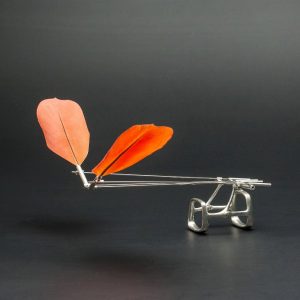
    A pair of feathered wings flaps as the wearer bends the finger with hinged rings. These interactive flapping wings on the tip of the finger evoke an emotional connection from the wearer as if holding a fragile life. What concerns the process, I create the main parts by computer modelling, 3D printing, and casting. Mechanical parts are fabricated from tubing and wire using traditional silversmithing technique. This merge of new technology and traditional handwork blurs the border between the designer, the engineer and the craftsman and gives me a true liberation as a Maker.

    Silver, 16×12×7,5cm

  • Eglė Čėjauskaitė-Gintalė, 2016, Lithuania

    Eglė Čėjauskaitė-Gintalė, Lithuania

    Connections

    Connections: carrying, connecting, hiding, concealing different interconnections.

    Silver, 10×10cm

  • Ela Cindoruk, 2016, Turkey

    Ela Cindoruk, Turkey

    Pink Yaz

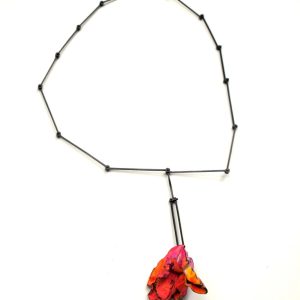
    I love orchids. They blossom beautifully and fade beautifully.
    I loved the forms the owers were taking as they dried on the stems so much that I left them untouched and they dried as they were.
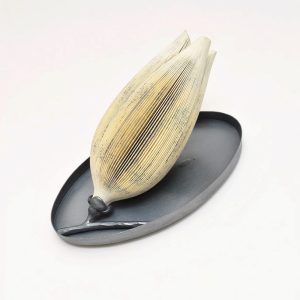
    I electroformed the dried orchids with copper and silver. They became immortal. After silver plating, they were sandblasted, spray-painted and patinated. I made mostly necklaces with the simplest chain possible, in order to emphasise the beautiful orchids. Each piece is unique.

    Dried orchid, electroplating, spray paint, 13×30cm

  • Elisabeth Habig, 2016, Austria

    Elisabeth Habig, Austria

    Radici dell’anima

    The work series Radici dell’Anima was inspired by nature. The pieces grew in a very intuitive way, like small trees in my hands instead of a fertile soil. Their garden is the human body where the jewellery is a worm. The cast channels are their roots, which show where they belong to and how they were made. The channels are left intentionally as an aesthetic element to refer to the bond between the piece and the crafting process – not only physically, but also on the mental level. Radici dell’Anima, which means ‘the roots of the soul’ show how the works are connected to my personality and me. This series binds my inner contrasts, which find a form in metal.

    Silver, 6,8×4,5×3,5cm

  • Felicia Mülbaier, 2016, Germany

    Felicia Mülbaier, Germany

    Parvus Corpus I/XV

    The work series Parvus Corpus I–XV explores the diversity of forms created by chance.

    Each object is made of 38 grams of steel wool and undergoes the same treatment process using the same tools. The result is the objects that roughly resemble each other in their dimensions and shape, but differ significantly in their impression.

    Steel wool, silver, stainless steel, 20×14×10cm

  • Hester Popma van de Kolk, 2016, Netherlands

    Hester Popma van de Kolk, Netherlands

    Gold of the world II (not all that glitters is gold)

    Global Gold, golden shapes bonded together, resembling the map of our world. At a closer look, the shapes are chips of SIM cards, the visual part of an invisible world of communication, linking people, cultures, businesses, covering huge distances in a fraction of a second. Taken from their phones, the chips have ceased to communicate. The last fragments of information are locked into these golden shapes and communication has ended. Or has it? Perhaps new thoughts will be inspired by all the con- nections that were once formed through these chips and its wear- er will charge this piece of jewellery with unique new meanings.

    SIM and credit cards

  • Holland Houdek, 2016, USA

    Holland Houdek, USA

    Femoral stem with rheumatoid nodule — hip replacement

    This series focuses on medical implants, the body, and embodied experience. Medical implants are the bonds that hold broken bodies together, where metal fuses with organic matter to extend and improve the lives of millions of people. These hand-fabri- cated objects glorify the highly individual and personal nature of prosthesis and surgeries, while evoking notions of memento mori and the fragile nature of the human form. Using real medical implants as inspiration, I have reinvented and exaggerated these devices for imagined bodies. The intention is for the viewers to consider their own physicality and to visualise the absent anato- mies implied by the work.

    Mixed techniques

  • Ilze Kibure, 2016, Latvia

    Ilze Kibure, Latvia

    Inheritance (neck jewellery)

    My grandparents Ieva and Žanis have left an amazing inheritance to me. They both were craftsmen. I combine the masculine, heavy and unclean metal-working of my grandfather and feminine, gentle handicrafts of my grandmother – crochet in the jewellery collection The Inheritance.

    Copper, silk thread, 44×3cm

  • Jee Hye Kwon, 2016, USA

    Jee Hye Kwon, USA

    Double

    Inspired by both organic forms and architecture, especially the buildings that are under construction. All the details and elements that go into making a building are beautiful, including the rebar, ferroconcrete, and ‘skeletal’ wood beams. However, in the best work, spirituality is also an important component. I use geometry and structural forces to suggest a power that shapes our emotional lives. Incorporated are also cellular constructions that illustrate a biological nexus, making the connection between a prodigious industry and the designs of nature. Lastly, explicit variations in size and shape promote feelings of movement and organic growth. Using classic goldsmithery techniques, each piece of work is meticulously fabricated and every cell is hand-soldered. My goal is to express the density and complexity of human experiences through different perspectives of architectural space, while maintaining a sense of lightness, exibility, and transparency.

    Oxidised silver, 18K gold, 14K gold solder, aquamarine, diamond

  • Joo Hyung Park, 2016, South Korea

    Joo Hyung Park, South Korea

    Fused 2

    I encountered a chance to break a piece, which represented my ideal as a jewellery artist. The expectations were low. However, I was able to find a different beauty, but it was still connected to me. There cannot be any alternation or compromise with your perfection. However, the beauty from denying my ideal led me to think about the possibilities of finding another beauty, which can also be considered as another perfection. By melting, crashing or peeling off the surface of a perfectly constructed object, I was able to create the pieces, which showed me the way to self-discovery.

    Brass, sterling silver, 6×11×1,5cm

  • Jordi Aparicio, 2016, Spain

    Jordi Aparicio, Spain

    Anima 42; Anima 43

    Going from precious material to the most primitive, I emphasise metaphorical meanings of shade, tinge, tint, and blandness. The result is a series of delicate and profound works, in which I express the fears and obsessions that live in me.

    Silver, marble powder, acrylic paint, silver wire

  • Kamran Babrak, 2016, Pakistan

    Kamran Babrak, Pakistan

    Metallic bonding of humans

    The bonding connection of metals to humans is as old as the birth of first human being. Iron (Fe) in the blood links to the system that channels energy. The stronger conducting qualities of metal in the blood are, the greater energy it receives. Atomic states of metals like Au or Ag have more magical properties than any other metal due to their high conductivity. These bonds of blood are universal and make every human being naturally equal to other human beings, unify people more effectively than any language. It is a collective shared experience in the code of our blood. Relating to this, my work explores the bonding connection of a human body within the traditions of Corpus. It further expands its claim to see and explore human bonds recognised through common sharing and use of precious and non-precious metals in daily life, traditionally as well as collectively, through craft, through techniques, through using objects, through self-adornment, and through commonly recognised ideas.

    Copper, 16×12×4cm

  • Kate Bajic, 2016, UK

    Kate Bajic, UK

    Endurance (brooch)

    I have always had an affinity for working with metal. During my training as a jeweller I created small-scale, intricate models out of brass and copper shim, as I preferred to work directly with materials rather than sketch out concepts. I still work intuitively with materials and let them lead me in the process of making; happy accidents and discoveries can be the basis for new designs.

    My current work is inspired by lichen and seeks not only to create beautiful, tactile, wearable jewellery, but also to inform both the wearer and the viewer in surprising ways, by adding details, such as chemical compound structures, which relate to specific lichen species and their functions in the wider world.

    Silver, oxidised silver, 8×7×2cm

  • Katja Toporski, 2016, USA

    Katja Toporski, USA

    Vanitas = History × Space 2

    Each of these pieces contains two fragments of castings of white material. One is in the shape of an hourglass; the other one is a 3D model taken by the Rosetta space probe from the Churyumov-Gerasimenko comet. They speak of space, its complex relation to time, and the human quest to understand our place in this world. The third component, a cylinder made of intricately pierced silver, connects those two parts together. Its pierced outlines follow the lines painted by the cavemen in the Chauvet cave in Southern France, depicting the hunting scenes of wild animals, bearing the mysteries of cultural expression. While the silver cylinders in the pieces add their own part to the story, silver is also employed to connect all three parts together, acting as the unifying material to all three.

    Silver, porcelain, 8×6×4cm

  • Kätrin Beljaev, 2016, Estonia

    Kätrin Beljaev, Estonia

    Blown by the wind

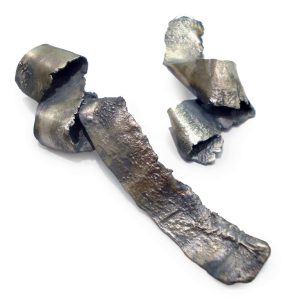
    Light brooches made of thin metal sheets are part of the series Thule that I have created before. Gone with the Wind – drawing by hand and shaping metal like an old paper letter in the wind represents speed and natural textures.

    Silver 925, copper

  • Katrin Feulner, 2016, Germany

    Katrin Feulner, Germany

    Arbeiten 1507

    The German word Arbeiten, or work in English, refers to both the process and the result. For me, working, doing work, is the connection to the world that surrounds me. It is the link between social, mental, and physical activity. My jewellery is made out of found metal objects. Often I do not know their original function and context. I disassemble them and then create sculptural, wearable forms in an intensive and slow process of growth and development.

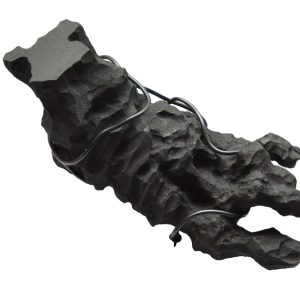
    Iron, steel, 35×16,5cm
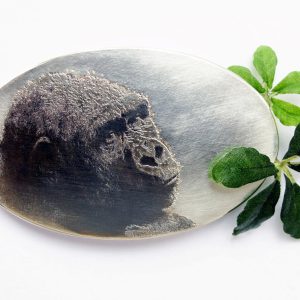
  • Kim Ji-Young, 2016, South Korea

    Kim Ji-Young, South Korea

    Links of the wind

    We laid down still in a straight line
    and closed our eyes to see the things we could not see with just our eyes.
    I wish there was an actual station somewhere called
    Eternity…
    There is one straight path
    and we spend our lives staying and staying on that one path but there are other ways besides my own.
    Other people say their paths are straight.
    My studio is between North Korea and a cease-fire line made of barbed wire.
    Metal can divide and make a boundary where the end is unknown.
    The metal dreams again today. Like a Möbius strip.

    Sterling silver, acrylic, gold-plated stainless steel, 11×2×4,5cm
  • Lena Lindahl, 2016, Sweden

    Lena Lindahl, Sweden

    Mother

    Family. What are our bonds? Which one is the strongest?
    Being an artist mainly working with silver I feel strongly about my favourite metal. Its plasticity, its many shades and the sensuality in the meeting with the skin always inspire me. The strongest bonds though for all of us humans are the ones to nature and family. No matter what paths we may follow in life we will always carry our childhood and our family bonds within. And wherever we choose to go we will depend on nature in order to survive. I want my brooches to be reminders of these bonds. I think we need it.

    Sterling silver, artificial plant, 10×7cm

  • Lital Mendel, 2016, Israel

    Lital Mendel, Israel

    Oops

    After a few collections dealing with repetitive patterns, order and structure and making very delicate pieces, I got sick of it all. I felt like destroying, burning, tearing jewellery apart. In my work, I tried to preserve the exact moment between designed and deformed – still distinctly relating to my previous collections but less inhibited, more unplanned, maybe even reckless. The process involved taking jewellery from previous collections and then applying all sorts of material manipulations on them allowing me to simultaneously preserve some part of the old object while disfiguring other parts.

    Silver, epoxy resin, paper, 40×8,5×1,5cm
  • Placeholder

    Louise Seijen ten Hoorn, Israel

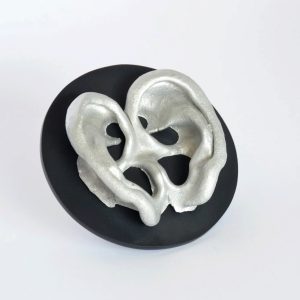
    Dualism #1

    The rigid black square steel frame contradicts the soft white flowing silver form. Together they express a unified vision of opposing forces. In The Marriage of Heaven and Hell, the poet, painter and printmaker William Blake described duality to be the source of creation and necessary for existence. Metal offers the possibility to convey both hardness as well as soft fluidity – in appearance as well as in the way it is worked. A combination of hand-carving, casting and constructing are used to create this one-of-a-kind piece.

    Steel, silver, 7×7×7cm
  • Maja Houtman, 2016, Netherlands

    Maja Houtman, Netherlands

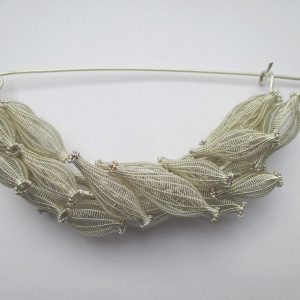
    Fibula Nubifera

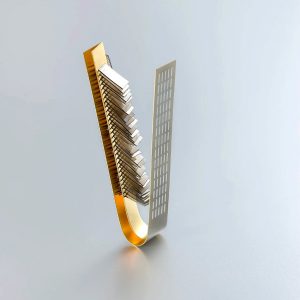
    The brooch or cloak pin “Fibula Nubifera” is literally an ornament intended to make a bond, where the thin silver wire binds all loose parts together into one firm entirety.

    Sterling silver, 15×7×3cm

  • Marie Grewenig, 2016, Germany

    Marie Grewenig, Germany

    O(H)RDEN

    For my jewellery I use the means of expression which I know best and which is the most intimate – my body. Using my body I can visualise gestures, sentiments, and emotions that are associated with different meanings. I try to focus on parts, gestures or on actions, which seem to be profane and self-evident. The resulting imprints of the body form new bodies. They seem familiar but also strange and vague at the same time.

    On the subject of BONDS, I focused on the act of listening. Listening is the basis of our daily communication and an important connection for our daily cooperation. It is too often judged as natural and is not esteemed. By my work I emphasise the good listening and appreciation for it.

    Aluminium, synthetic material, 8×8×4cm

  • Marie-Louise Kristensen, 2016, Denmark

    Marie-Louise Kristensen, Denmark

    The man in the hat

    My creative process and the narrative way of working enables me to bond with, reflect on and understand the world around me. I work with impressions and moods and combine them with quotations from the world of art. My works deal with design icons, which comprise a static and recognizable form, also hold a diffused memory and surreal narrative… My works are created in close dialogue with what is currently taking place around me. The renovation of my bathroom introduced me to a whole new world of taps. Alongside this, I’m fascinated by the headlines in the breaking news feed and the spam-box in my e-mail program; I handpick texts from the subject fields, thereby collecting both titles and inspiration for my Works.

    Silver, gold, epoxy putty, opals, amber, pearls

  • Marina Sheetikoff, 2016, Brasil

    Marina Sheetikoff, Brasil

    Amulet I; Amulet II

    The pieces of jewellery are signs to be worn on the body, which connect people by their visual language.

    These amulets are pieces inspired as sources of protection and force. The shapes of the fig sign and pepper, inspired by traditional Brazilian balangandan bracelets, since ancient times have been representing strength, radiation of light, vitality, and protection at the spiritual level.

    Niobium, the metal that I choose to use, gives the blissful possibility to explore its magnificent colours reflected by its oxidised surface. 100% anti-allergic, immediately reaching the body temperature when in contact with the skin, it serves perfectly for making jewellery.

    Niobium, 6×15×0,8cm, 4×20×0,8cm

  • Masako Onodera, 2016, USA

    Masako Onodera, USA

    Topology

    As a metalsmith I find interest in silver-plated house wares in antique stores, which are rarely used at home nowadays. It is hard to keep them in good condition and not to ruin the top layer of silver. These objects of very low monetary value have pretended to be “family inheritance” and became just a symbol of the female family members in the past in someone’s home.

    Objects exist for decades, centuries or even millennia. Their functions transform over time from utilitarian to symbolic, from direct use by their owners to a ritual, indirect use. Despite their inanimate existence they stipulate a sense of space and time with their tactile and visual sensations. I am attracted to their quiet, flexible but robust presence. Objects are loaded with their stories and functions as well as the trace of hands that have touched them.

    Leather, silver-plated parts of jugs, thread, cotton, sterling silver

  • Melis Agabigum, 2016, USA

    Melis Agabigum, USA

    Uroborus: your proposed fight goes both ways [I am wounded]

    With each piece, I explore materiality and the physical or emotional connections that occur between body and jewellery. The notion of burden comes in many forms; there are regrets that weigh heavily on the soul, small fixations that develop into obsessions, emotional weights that stem from one person or are shared, and so forth. I view my work as forms that traverse the line between jewellery and sculpture. They are sculptural objects that can interact with space and with the individual through the physical connection when wearing. Burdens become a responsibility, and in a similar manner, making these forms becomes onus for me. The experience of repeating an action like crocheting flows from my responsibility to and for the objects. Ambiguous, skeletal-like vessels develop from the subconscious motions that my hands enact. The act of making becomes a ritual of giving and taking, resulting in a materialization of my emotional investments in fixating, obsessing, and working through a problem.

    Mixed media

  • Michihiro Sato, 2016, Japan

    Michihiro Sato, Japan

    Not two different things

    It is said in Buddhism that being alive is the manifestation of life and being dead is the latent form of life, so both of them are just different appearances of life and not two different Things.

    Silver, paper, stainless steel, 11×6×6cm

  • Minna Karhu, 2016, Finland

    Minna Karhu, Finland

    Silence

    Bonds can be good or bad or both at the same time. Words are not always even necessary to describe things. The silence is a powerful way of expression and sometimes it is enough.

    Bronze, paint, waxed cord, 5,2×7,8×2,8cm

  • Nazan Pak, 2016, Turkey

    Nazan Pak, Turkey

    Hydrangea

    Much of life is composed of reproduction and repetition that I have always found fascinating. My work is also comprised of the combination and repetition of geometric shapes, mostly spheres, semi spheres, their derivations and deformations. In these com- positions, I achieve harmony, texture and pattern by multiplying, extending and reducing these two- or three-dimensional pieces. Enamel gives me the exibility to accentuate these features.

    Silver, enamel, 6×30cm

  • Nicole Jacquard, 2016, USA

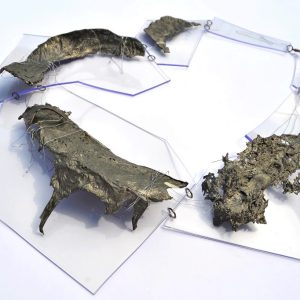
    Nicole Jacquard, USA

    Pink passion

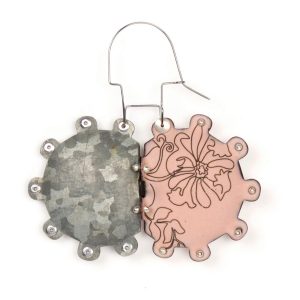
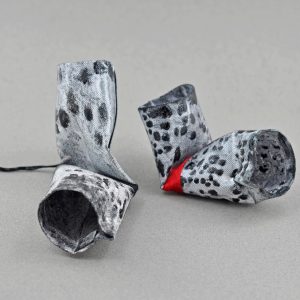
    These brooches are from a series called High Tech/Low Tech. They investigate the combination of historical and innovative materials and processes.

    All brooches relate to letting go of the past (galvanised steel pod & felt form) and highlight the beginning of new relationships (laser engraved enamelled pod forms). Through the combination of metal and ornamentation I wish to visually represent the struggle or ties one can have when trying to move forward and the beauty of “letting go”.

    Mixed media

  • Nik Hanton, 2016, New Zealand

    Nik Hanton, New Zealand

    Memory palace II

    We lock our raw memories in miniature palaces to retrieve and examine from every angle. Our distance from them does not make them any less real. Only more bearable.

    Nik Hanton

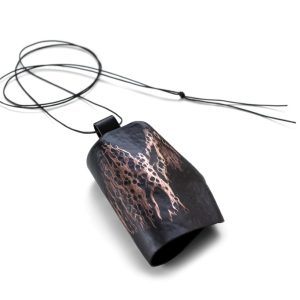
    This series comprises a number of Memory Palaces which contain moments from the makers past, which bind her to the present. Made from a variety of metals, the materials express the content of the individual palaces. Some are rounded, weighty and burdensome to bear, others light and sharp. The manifestation of these recollections as neckpieces creates a bond between the maker’s internal world and the external world expressed through her use of metal.

    Oxidised copper, brass, leather, paint, 47×6×3,5cm

  • Niklas Link, 2016, Germany

    Niklas Link, Germany

    Bonds in thoughts

    Bonds in thought
    What if..?
    What if I experienced war?
    Would it be written on my face? – From the freedom of a mask to the personal touch of a caricature to the generality of a symbol. Those are the main aspects of my jewellery. The hollow bodies made of steel always develop from sketches, which are based on self-portraits. This way, conventionalised and three-dimensional images come into existence. I integrated parts of synthetic war toys into these brooches in order to start an argument in thought concerning these questions.

    Steel, sterling silver, lacquer, synthetic accessories, stainless steel

  • Ramunė Jundaitė-Misevičienė, 2016, Lithuania

    Ramunė Jundaitė-Misevičienė, Lithuania

    Flying I, II, III

    A free, giant, weightless, filled with air, it is floating across the blue sky. It is on its journey through time, haunted by the childhood dream to fly up and melt in the sky. A floating hot air balloon makes you look up and this momentary vision, an experienced emotion, perceived as freedom, illusion and aspiration, is etched in your memory forever. It is this momentary vision that inspired the brooch collection Flying based on a conception that comes close to the perception of the object. The Flying objects in a sense become intermediaries between heaven and earth. They serve as a continuation of history, showing us how things might be. They represent the flight of the soul, the relationship with another realm beyond our sight. Lightness, volatility, and aspiration. These are connections that link us to the spiritual realm.

    Silver, enamel, 4×2,5cm, 6×3cm

  • Ria Lins, 2016, Belgium

    Ria Lins, Belgium

    Retreat

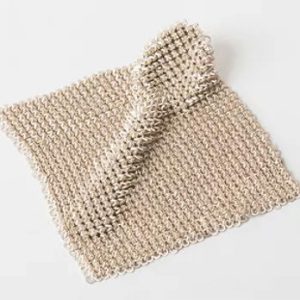
    Amazement at interpersonal relationships and the adaptability to the diversity of our society are the threads that can be found throughout my work. Due to the weaving technique my pieces remind of old purses or chain armour. It feels historical and contemporary at the same time. People can feel the stories or shared experiences behind my work, even though they may not be aware of them. Once the piece is made, the memory has found its place, and there is no need to explain it or its details. As the piece is worn and shown, it will get its freedom of existence and enrichment.

    Cuddle is really meant as a memorial piece. I was inspired by a story about a woman who kept pieces of fabric sewn in the hem of her dress as a way to remember someone who was deceased. One can also put small objects into Cuddle to remember someone.

    Silver, silk thread, 50×4×8cm

  • Roberta Pavone, 2016, Italy

    Roberta Pavone, Italy

    Lacrime Arti Ciali (Artificial tears)

    Shaping metal in different languages but with the same passion.

    Oxidised silver, 5×2cm

  • Romualdas Inčirauskas, 2016, Lithuania

    Romualdas Inčirauskas, Lithuania

    Third day

    This work is an attempt to embody the relationship between the CREATOR and the Artists.

    Then God said: “let vegetation sprout all over the earth, including seed-bearing plants and fruit trees, each kind containing its own seed!” And that is what happened: vegetation sprouted all over the earth, including seed-bearing plants and trees, each kind containing its own seed. And God saw that it was good. The twilight and the dawn were the third day.

    Genesis 1: 11-13

    Aluminium, bronze, 50×45×22cm

  • Rudee Tancharoen, 2016, Thailand

    Rudee Tancharoen, Thailand

    Temporary linked

    What are you and me?
    If not only a lump of dust, compressed with selfness, waiting for a day to disintegrate into fine dust again.
    However, during our existence we suffer.
    From desire to be and not to be, to have and not to have.
    We struggle, fight, protect, sacrifice, find excuses to hate and to love.
    This is how we are bonded to each other.
    The bond is unavoidable but realising that the bond is only temporary, the selfness and suffering is avoidable.
    Do you think, with harmony, two different entities can be together peacefully?
    What if harmony is not the key, but a trap?
    Searching for harmony is not different from searching for another identical pair.
    Not only about the objects but our human society as well.
    If being together peacefully is the goal, then “being together peacefully”, with or without harmony, is the key.

    Silver, dust, 20×35×1cm

  • Rūta Jurkūnaitė-Bruožienė, 2016, Lithuania

    Rūta Jurkūnaitė-Bruožienė, Lithuania

    Conceived. Day I, II

    What takes form by means of creation must not necessarily possess the qualities of an ideal work of creation. Let the light alternate with shadows, let it shimmer and sparkle, let the strings of threads grow into the web of steel, leaving a trace in it.

    Steel mesh, enamel, cotton thread

  • Ruudt Peters, 2016, Netherlands

    Ruudt Peters, Netherlands

    Terram “Lurra”

    We walk the world on our feet, but we are not aware that our feet do more than merely carry us. Our feet are necessary tools to move, but they also root us to the ground. I emphasise awareness of my place as a jewellery maker in the world of body and mind. Terram helps me to connect the micro- and macrocosm, the upper world and the underworld. Step on the ground.

    Silver, modelling material, 14×6×8,5cm

  • Serena Holm, 2016, Sweden

    Serena Holm, Sweden

    Sengen-Sama

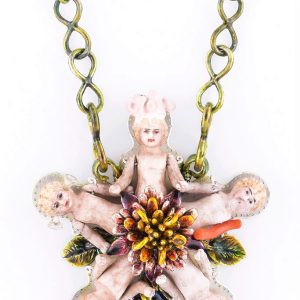
    Sengen-Sama is a Japanese goddess of fertility. According to the legend, Sengen-Sama makes flowers bloom, and similarly she can make our lives blossom into maturity. She is also the essence of cherry blossoms, which represent the beauty and fragility of life. In my Sengen-Sama, a chain built of loops shaped like the infinity sign and painted in shades of green ends in a flower made of cast silver enamelled in all the colours of the rainbow and five dolls joined at the hips. Each doll portrays a human ability. Five senses: sight, hearing, speech, imagination and humour. One of them also carries a prosthesis, a symbol of both the ephemeral and the creative. Sengen-Sama represents our bond to life and to each Other.

    Silver, antique doll parts, glass, coral, enamel, 8×8×3cm

  • Simona Girelli, 2016, Italy

    Simona Girelli, Italy

    Links

    My project is related to the alternative use of materials and recycling. This work is a satellite view of the whole, in which the geometrical PVC elements represent states, people, traditions, while metal symbolises the unifying element. Connections which eliminate distances and create indissoluble bonds… connections which eliminate the space and time by merging the past and the future, the ancient and the contemporary… connections that are rooted in the environment by breaking down boundaries and borders and fostering eternal dialogues.

    Industrial metal waste, plastic, 30×33cm

  • Una Mikuda, 2016, Latvia

    Una Mikuda, Latvia

    Natural blonde

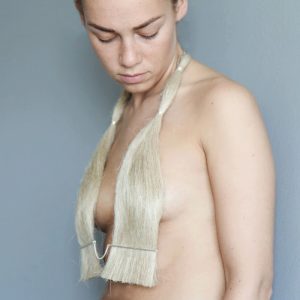
    A human being was created by nature and each person’s beauty was given by nature. Mother Nature is like an inconceivable and unlimited beautiful woman, and man is a part of it. It has an intangible force, with which it is able to simultaneously create and destroy. It is not predictable or restricted. I comprehend a part of this elusive, beautiful force of nature, set boundaries giving a concrete shape and form, and give an opportunity for people to adorn themselves. I create interactions – a man created by nature adorns himself with its beauty.

    Natural blonde – golden natural beauty in a tangible form – linen. Linen fibre combined and enhanced with metal without losing its untamed beauty.

    Linen fabric, silver 925, 35×25cm

  • Vincent Pontillo-Verrastro, 2016, USA

    Vincent Pontillo-Verrastro, USA

    Sotil

    The term “analogous” describes the likeness that permits one to draw an analogy. An inference that two or more things agree with one another in some respects, and will probably agree in others.

    Analogous directly applies to “things”, physical, tangible things, belonging in essentially different categories, but nevertheless having many similarities. The term analogous in many respects describes my approach to the studio and act of making artwork, integrating digital fabrication techniques and materials directly into my daily practice. In synthesising analogous qualities, I seek to develop a visual conversation reflecting material language and appropriation.

    PLA stainless steel composite, wood dust composite, stainless steel

  • Vita Pukštaitė-Bružė, 2016, Lithuania

    Vita Pukštaitė-Bružė, Lithuania

    Coincidence

    Is the connection between coincidences accidental? Directions for use of the artwork: flip horizontally and shake it a bit, then flip vertically before hanging It.

    Copper, enamel, aluminium, steel, wood, 45×16cm

  • Wu Ching Chih, 2016, Taiwan

    Wu Ching Chih, Taiwan

    Heart (series “Squares”)

    Using electric forming, i have transformed found objects into metal and then restored the original colour and shape with enamel. My message is the question whether the value of found objects still remains after the transformation. In addition, I have also inserted the concept of jewellery and sculpture into this piece by taking the jewellery’s functionality as a partial form of the object. Hence, the work no longer only serves a function, but also expresses the concept of a micro-sculpture. This group of works was created with a sculptural concept in mind, and as for material performance, the contrast of smooth and coarse texture was created.

    Copper, enamel, plastic, 4×4×18cm

  • Ying-Hsien (Eunice) Kuo, 2016, UK

    Ying-Hsien (Eunice) Kuo, UK

    Fall

    This project is dedicated to people who have ever struggled in love. Each metal ring represents a being. Due to gravity, the metal rings dropped further, gradually through time, their weight of the rings determines the speed at which they drop. Søren Kierkegaard’s ‘Theory of fall’, regarding anxiety, is delivered. Psychologist Robert Sternberg’s ‘Triangular theory of love’, regarding relationship, is symbolised as triangular metal units. The use of solid tape materialised the complex emotions that we have in an unpleasant relationship. Tape is representative of the mind in this state. It sticks to anything and in turn possesses. The minimal shape and the solidity of metal bring out the most fundamental characteristics of this material. This allows metal units to have some certain interactivity with the tape; rolling, falling, trimming and holding pieces are actions that link to its forms.

    Bronze, sterling silver, adhesive tape, 14×3,5×12cm

  • Yu Hiraishi, 2016, Japan

    Yu Hiraishi, Japan

    Moving line (pink brooch)

    Three-dimensional lines drawn in space. Although these pipes are fixed and soldered, it looks as if they are moving when changing the viewing angle. These pieces can be seen as forms of completely different lines. The works represent the variety of elements.

    Brass, urethane paint, silver, 9×11,5×4,8cm